Blog
-
5 Signs of Schizophrenia Everyone Should Know
5 Signs of Schizophrenia Everyone Should Know
Schizophrenia symptoms explained — Learn the 5 core domains: delusions, hallucinations, disorganized speech/thinking, abnormal motor behavior (including catatonia), and negative symptoms, and how they cause functional decline. This clear, clinician-friendly breakdown will help you spot signs, understand psychosis, and know when to seek help.
In this video we break down schizophrenia into its five core domains — delusions, hallucinations, disorganized speech/thinking, abnormal motor behavior (catatonia), and negative symptoms — and explain how these symptoms lead to major functional decline. Whether you’re a student, clinician-in-training, or someone wanting to better understand a loved one’s experience, this short guide gives clear examples, clinical tips, and next steps.
Why watch — This video focuses on the most searched questions about schizophrenia: “what are the symptoms of schizophrenia”, “psychosis vs schizophrenia”, and “what does hallucination look like” — making it ideal for students, families, and general audience.
Resources / Further reading
Reliable overviews: WebMD, NHS, Johns Hopkins (search “schizophrenia symptoms WebMD / NHS / Johns Hopkins”).
#schizophrenia #psychosis #mentalhealth
#zohaibmindscope @MindScope_Psychology
If this helped — hit LIKE, SUBSCRIBE & ring the 🔔
COMMENT: Which domain surprised you most? Share questions and I’ll answer the top comments in the next video.
🔗 Connect with Me:
🔔 Subscribe to MindScope_Psychology for weekly psychology lessons:
👍 Like, comment, and share — and tell me which CBT principle you want a deep-dive on!
📣 About the Creator
Zohaib Ali — MS Clinical Psychology candidate (Riphah International University). Founder of MindScope Psychology, I create evidence-based videos on mental health, therapy techniques, and psychological research for students and the public.
Instagram: mindscope_psych
Tiktok : Mindscope_Psychology
X (Twitter): MindScopePsych
LinkedIn: ZohaibAli-Zohaibmindscope
Dailymotion: Mindscope_Psychology
-
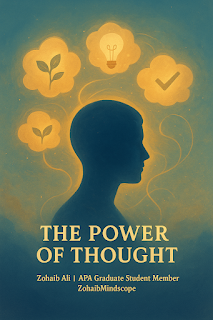
Why Our Thoughts Matter: The Hidden Power of Conscious Thinking
Why Our Thoughts Matter: The Hidden Power of Conscious Thinking
Have you ever stopped to wonder — why do my thoughts matter so much?
It’s because our thoughts quietly create the blueprint of who we become. Every interpretation, belief, and moment of self-talk guides how we feel, behave, and respond to the world around us. The mind is not a passive observer — it’s the architect of our reality.
As a Clinical Psychology student at Riphah International University and a proud APA Grad Student member, I’ve learned that thought patterns aren’t random noise. They’re mirrors of our perception, shaped by experience, emotion, and awareness.
When we train our minds to think consciously, compassionately, and critically, we craft a life that’s both emotionally resilient and purpose-driven.
💭 1. Thoughts Create Perspective
Your thoughts define how you view the world.
Do you see challenges as obstacles or opportunities?
Your perspective determines your resilience. People who engage in positive cognitive reframing—a key concept in Cognitive Behavioral Therapy (CBT)—can turn adversity into growth.“Change your thoughts, and you change your world.” — Norman Vincent Peale
💬 2. Thoughts Drive Emotion
Every emotion begins with a thought.
Healthy, balanced thinking fosters emotional regulation and stronger relationships.
When you catch yourself spiraling into negative self-talk, pause. Ask:“Is this thought helping or harming me?”
Building emotional intelligence starts with this awareness.
🌱 3. Thoughts Inspire Change
Growth begins when awareness meets action.
A single reframed thought can shift your behavior, improve your confidence, and transform your daily life.
In both therapy and personal development, the journey begins by simply noticing what we think — and why.When you cultivate empowering thoughts, you’re not just changing your mindset — you’re rewiring your brain through neuroplasticity.
💡 Practical Tip:
Start your day with one intentional thought:
“Today, I choose to think with clarity, kindness, and courage.”
Repeat it until it feels natural. Over time, your brain adapts — and so does your reality.
✨ Final Reflection
Our thoughts matter because they are the foundation of everything we are and everything we can become.
When we think with awareness, we live with purpose.So, ask yourself:
What’s one thought that changed how you see yourself lately?© 2025 Zohaib Ali | MindScope Psychology
MS Clinical Psychology Student – Riphah International University | APA Grad Student Member
👉 YouTube: @mindscope_psychology 👉 LinkedIn: Zohaib Ali MindScope Psychology
👉 More links: https://linktr.ee/ZohaibMindscope
.jpeg)
-
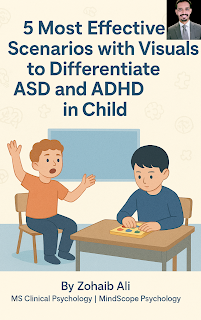
5 Most Effective Scenarios with Visuals to Differentiate ASD and ADHD in Child
ASD vs ADHD – Five Clinical Scenarios Explained
Author: Zohaib Ali, MS Clinical Psychology Student, Riphah International University
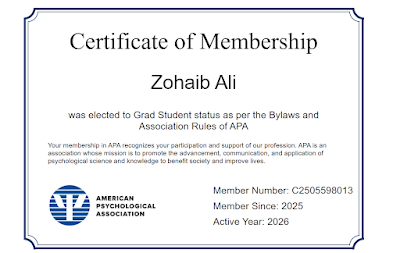
Membership: APA Graduate Student Member (ID: C2505598013)
Publisher: ZohaibMindscope.com | MindScope PsychologyThis educational mini-book explores the diagnostic and behavioral differences between Autism Spectrum Disorder (ASD) and Attention Deficit Hyperactivity Disorder (ADHD) through five original case-based clinical scenarios. Each scenario demonstrates how subtle features in cognition, emotion, and social interaction can guide accurate assessment and intervention planning.
📘 About the Book
“ASD vs ADHD – Five Clinical Scenarios” is designed for psychology students, educators, and clinicians who wish to sharpen their diagnostic understanding. The book includes vivid case illustrations and AI-generated visuals to enhance conceptual clarity.
💡 What You’ll Learn
- How ASD and ADHD symptoms overlap and differ
- Diagnostic reasoning using real-world case examples
- Understanding social, cognitive, and behavioral markers
- Visual representations of symptom patterns
📥 Download or Read Online
Click below to download the complete illustrated book (PDF):
Or view directly below:
🎓 Citation
Ali, Z. (2025). ASD vs ADHD – Five Clinical Scenarios. ZohaibMindscope.com / MindScope Psychology.
🌐 About the Author
Zohaib Ali is an MS Clinical Psychology student at Riphah International University, Pakistan, and an APA Graduate Student Member. He is the founder of ZohaibMindscope.com, an educational platform that promotes mental health awareness and psychological research through digital learning resources.
© 2025 Zohaib Ali | MindScope Psychology | APA Graduate Student Member | All Rights Reserved
-
Welcome to Zohaib Mindscope — A Journey into Psychology, Research, and Mental Health
Psychology is more than a subject — it’s a journey into understanding the human mind, behavior, and emotions.
I’m Zohaib Ali, an M.S. Clinical Psychology student and a proud Graduate Student Member of the American Psychological Association (APA). My goal with MindScope Psychology is to create a space where knowledge meets empathy — making psychological concepts clear, practical, and relevant for everyday life.
Here, you’ll find insights on mental health, therapeutic approaches, research methods, and emotional well-being — all written with academic integrity and genuine curiosity.Whether you’re a psychology student, a mental health professional, or simply someone passionate about understanding the mind, MindScope Psychology welcomes you.
Thank you for joining this growing community.
© 2025 Zohaib Ali | MindScope Psychology
Graduate Student Member, American Psychological AssociationZohaib Ali — learn mental health simply.
Profiles: X · Youtube – Instagram · TikTok · LinkedIn – Dailymotion – Medium


.jpeg)
.png)


