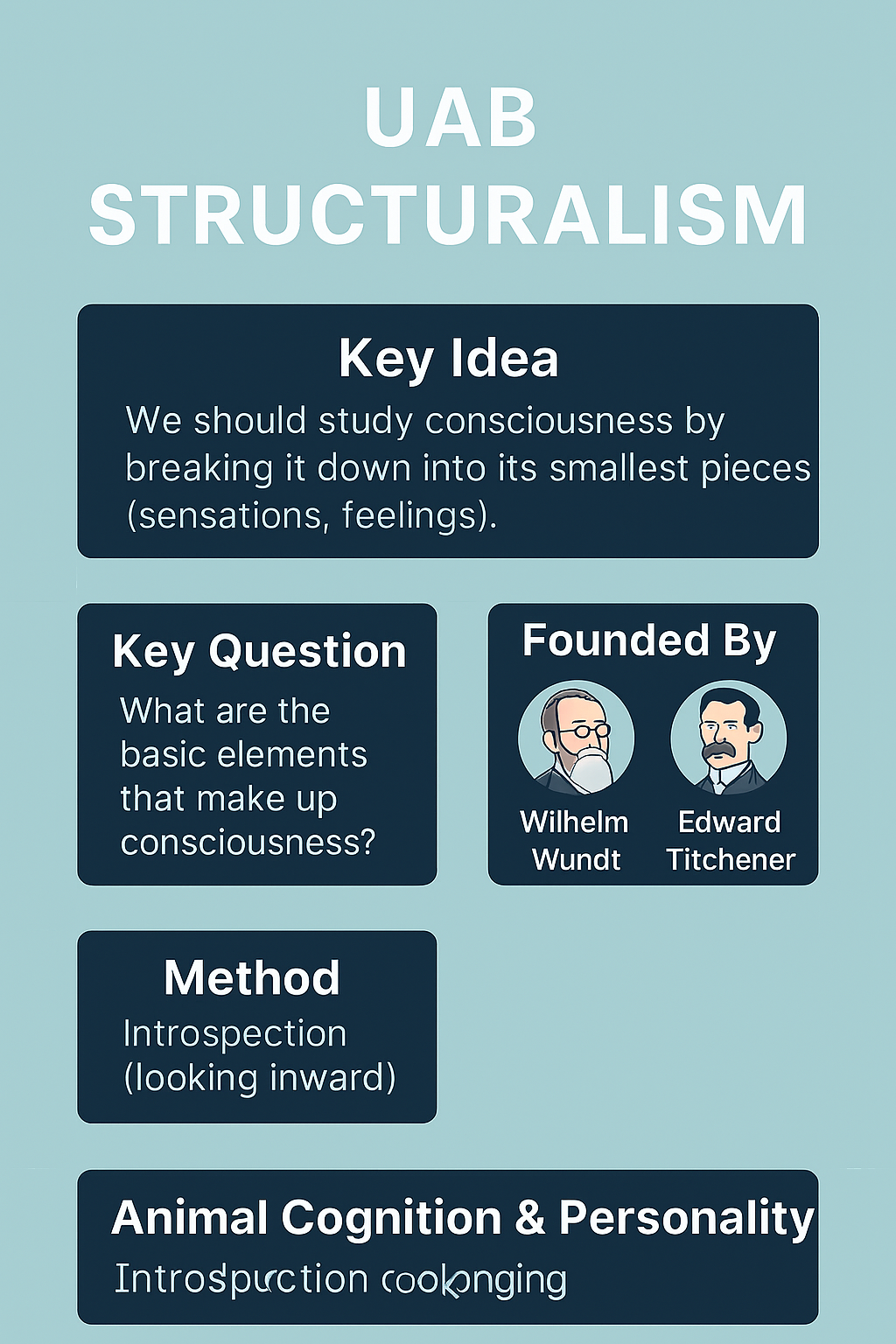
Structuralism in Psychology
An Early Scientific Approach to the Human Mind
🧪What Did Structuralists Do?
→They believed the mind could be studied like a science, applying systematic methods to mental processes.
→They used a method calledintrospection— asking trained subjects to describe, in detail, what they feel, see, or think immediately after a stimulus.
→Their goal was to find thebasic elements of thoughts— much like how chemists break matter into fundamental atoms.

🧠The Building Blocks of Consciousness
Structuralists focused on breaking down conscious experience into three primary, irreducible components:
Sensations
The direct input from the physical world (what you feel, hear, smell, or see).
Images
The mental representations of objects not physically present (what you picture or remember).
🧓Key Pioneers
Wilhelm Wundt: He is widely considered the father of Structuralism and, more broadly, of experimental psychology. He established the first formal psychology laboratory in Leipzig, Germany, in 1879.
Edward Titchener: Wundt’s student who brought a modified version of Structuralism to the United States, popularizing the school of thought in America.
📚Historical Importance
- Scientific Foundation: Structuralism played a crucial role in helping psychology break away from philosophy and establish itself as an independent, scientific discipline.
- Catalyst for Change: Its methods and theories served as the starting point and intellectual sparring partner for many other influential schools of thought in psychology that followed.
⚠️Key Criticisms
- Unreliable Method: Introspection was highly subjective and unreliable, as different individuals reported vastly different experiences for the same stimulus.
- Limited Scope: It struggled to study complex behaviors, animal psychology, emotions, or unconscious thoughts, which limited its explanatory power.
- Too Narrow: Later psychologists, particularly the Functionalists, argued that Structuralism was too focused on the *structure* of the mind and failed to explain the *purpose* or *function* of mental processes.
Leave a Reply